The fractal-art community has built up a large toolbox beyond what this project uses. This page collects the techniques I came across, with a few sentences on each and a pointer to where to read more.
Hand-directed fractal art
There is a long tradition of hand-directed fractal art, made with tools such as Ultra Fractal and Kalles Fraktaler. Artists choose particularly interesting deep locations, develop palettes around the structures there, and sometimes combine multiple coloring methods or layers. Examples such as Quiet Essence, Polinomial Mandelbrot, and Wolfgang Beyer's Seahorse Valley sequence show a level of local visual refinement that a generic automated search is not trying to reproduce. An artist can tailor a palette to the valleys and cliffs of a single image, and bring a level of taste in ways that the automated method I work on here isn't able to achieve.
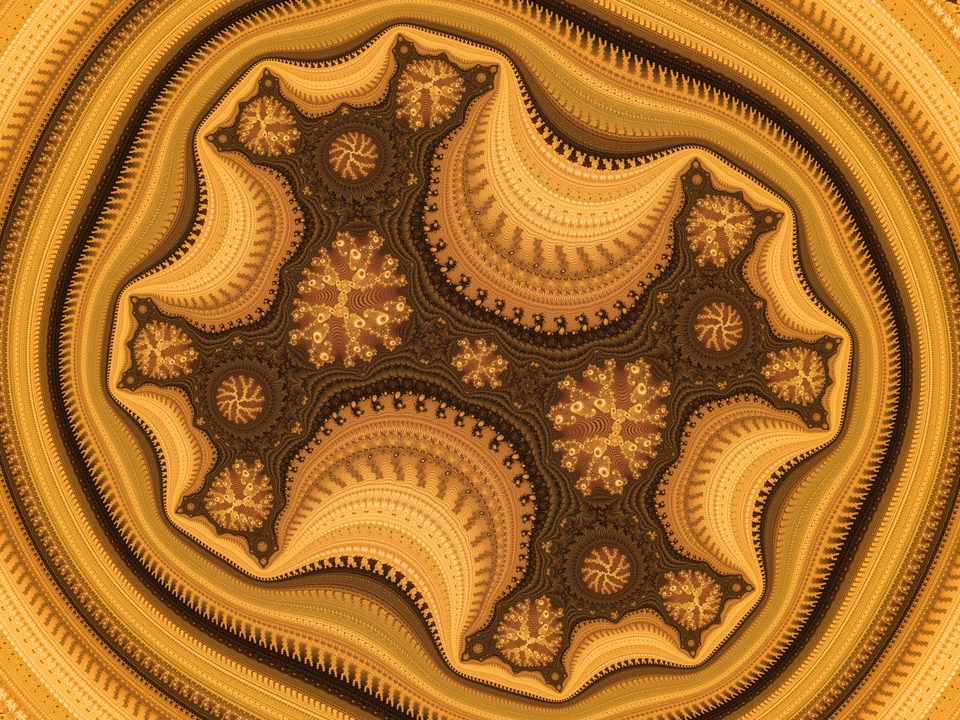
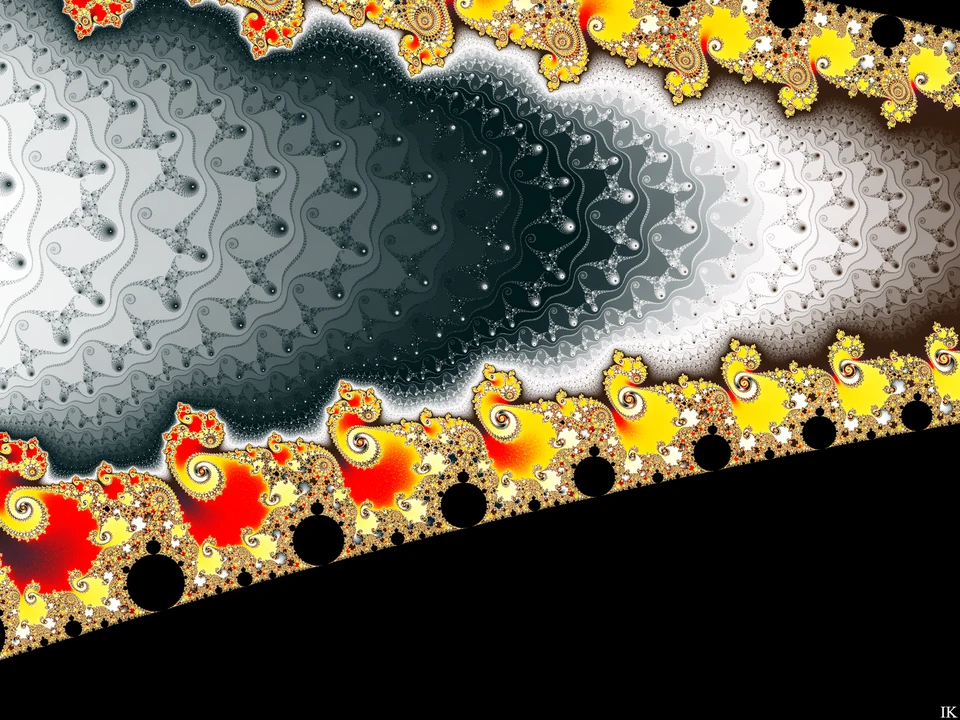

For more, see the deep zoom videos by Maths Town, the deep Mandelbrot galleries of DinkydauSet and Olbaid-ST, and the Ultra Fractal Showcase.
Julia morphing and inflection
Deep-zoom artists often steer slightly off-center on the way down to a minibrot. Each off-center choice is doubled into the decorations around the next copy, so a sequence of choices sculpts a pattern: stacked shapes, trees, X shapes, and "evolutions" of one shape into another. The wikibooks page on sculpting collects the vocabulary, and Claude Heiland-Allen's Patterns in Inflected Julia Sets analyzes it. Doing this for real takes enormous depth, but inflection gets the same doubling cheaply, by warping the plane around a chosen point before iterating. Heiland-Allen's Inflector Gadget does this in the browser, one click per step. I built an inflection tab for the Mandelnaut Explorer, and it worked, but they required a lot of expertise to use well and I didn't end up incorporating them into my fractal explorer.
Jumping to minibrots
Instead of zooming by hand, a renderer can solve for a minibrot's exact center with Newton's method and jump straight to it. The fractal explorer does this with Find minibrots and with the Deep tab's Dive block, and the minibrot descents are built on the same solve. Some tools also jump to the stages on the way down, where the decorations around a minibrot double in symmetry.
Exponential-map zooms
A whole zoom can be drawn as one long strip in log-polar coordinates, where every step deeper is the same distance along the strip. The frames of a zoom video are then cut out of the strip, so no point is computed twice. Robert Munafo's exponential map entry explains the transform, and this video shows a zoom made this way. For my zoom videos, I compute a field at every halving of the width instead.
Distance estimates and slope shading
Carrying the derivative of the orbit along with the orbit gives an estimate of each pixel's distance to the set, and its direction gives a surface that can be lit. That is the embossed, relief-lit look of much deep-zoom art. Arnaud Chéritat's notes on the normal map effect show how it works, and Eamonn O'Brien-Strain and Phil Thompson show it in artists' hands. It isn't one of this project's render modes: on its own I didn't think it worked well, though other artists use it all the time.
Inside the black
The interior of the set can be colored too. Interior distance estimates how deep a point sits inside its component, and atom-domain coloring shows which period each region belongs to (Heiland-Allen writes up both). About half of this project's render modes paint the interior flat. The rest are built on orbit traps and color it from each point's orbit instead, but none measure interior distance or atom domains.
Parabolic Julia sets
Parabolic Julia sets, taken at c just outside a cusp or bulb root of the Mandelbrot set, are a subject of their own. Orbits there crawl past the parabolic point so slowly that the pictures need huge iteration caps, and most come out almost entirely black, but the ones that work are striking. The Wikibooks chapter on parabolic Julia sets covers how to render them, and Arnaud Chéritat's mini-course on parabolic implosion covers the mathematics.