The mathematics behind these fractals runs deep, and I don't have enough experience with this field to follow the proofs of most of the results below. But it's a fun area, because so many of the theorems turn directly into tools for making pictures. This page lists some of my favorite highlights of fractal mathematics that I learned while making this project.
The Mandelbrot set is connected
Douady and Hubbard proved in 1982 that the Mandelbrot set is connected: every island that looks separate is joined to the main body by filaments too thin to see. Whether it is also locally connected is still open, as the MLC conjecture. A proof would give a complete combinatorial description of the set's shape.
Which Julia sets are connected
The Mandelbrot set is exactly the set of parameters c whose Julia sets are connected. Outside it, the Julia set shatters into a Cantor set of disconnected dust. Fatou and Julia showed around 1919 that it all comes down to one orbit, the orbit of zero, the map's critical point: if that orbit stays bounded, the Julia set is connected. That is why the Mandelbrot set is drawn by iterating from zero, and the same holds for every multibrot.
One attracting cycle
Fatou also proved that every attracting cycle pulls in a critical point. The maps z ↦ zd + c behind the Mandelbrot set, the multibrots, and their Julia sets have only one critical point, z = 0, since that is the only place their derivative d·zd−1 vanishes. So each has at most one attracting cycle, and following the orbit of zero will find it. The Mandelnaut Explorer uses this directly: on a Julia plane it finds the attracting cycle from the orbit of zero, then stops iterating any point that has provably fallen into it, which makes the interior of a Julia set almost free to draw in the render modes that leave it flat. Modes that color the interior by the extremes of its orbit can stop early too, once the orbit repeats exactly.
Minibrots everywhere
The minibrots are not just similar to the whole set. Douady and Hubbard's theory of renormalization shows that each is a genuine copy, distorted only slightly, and that copies sit arbitrarily close to every point of the boundary. This is the fact behind the minibrot descents, and it is why a patient search can find a good picture almost anywhere.
Tan Lei's similarity
Every parameter of the Mandelbrot set has its own Julia set, the starting points whose orbits stay bounded under that parameter's map. Zooming deep into a Julia set mostly isn't worth it. The map carries a small piece of its Julia set onto a larger piece of the same set, so a Julia set repeats itself at every scale, and a deep zoom mostly finds shapes it has already shown. The Mandelbrot set is different, because each of its points is a different parameter, so a deeper frame keeps meeting new Julia sets.
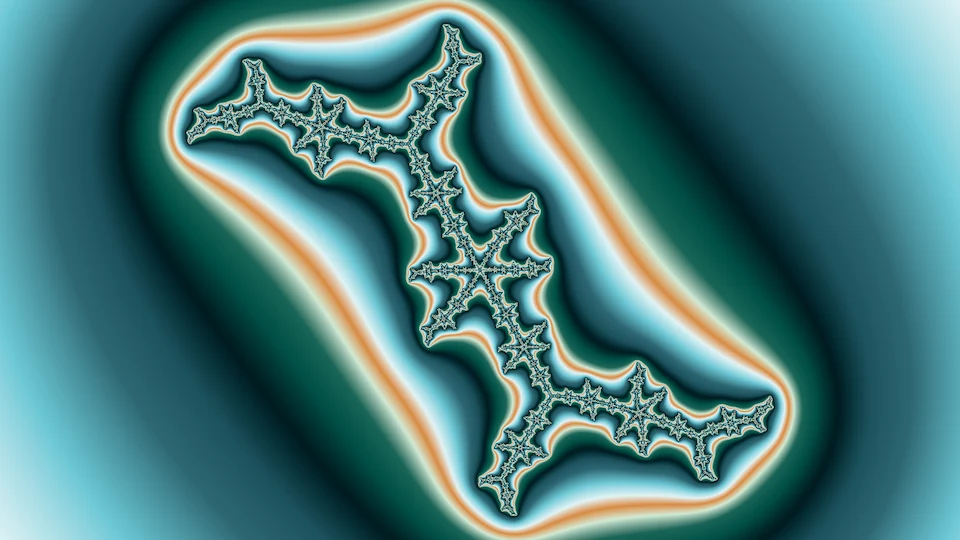
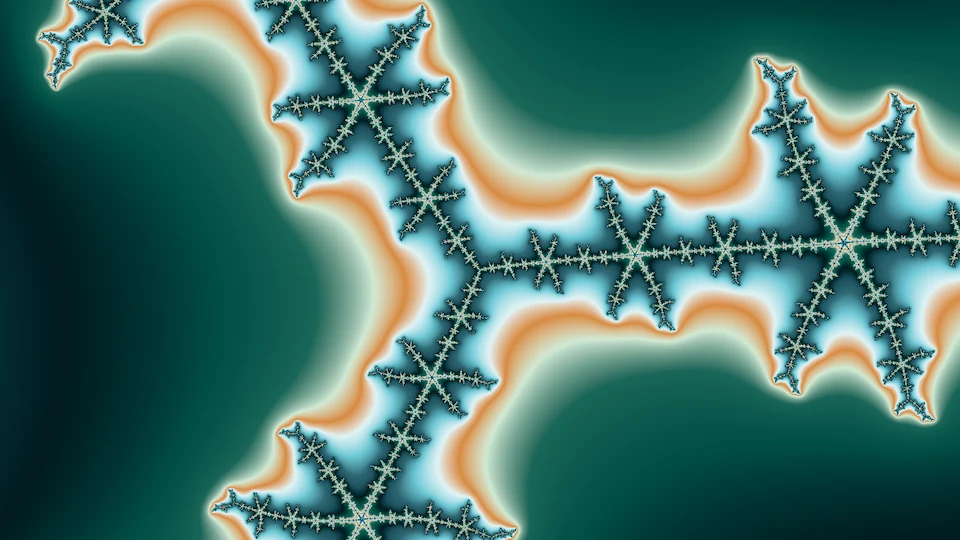
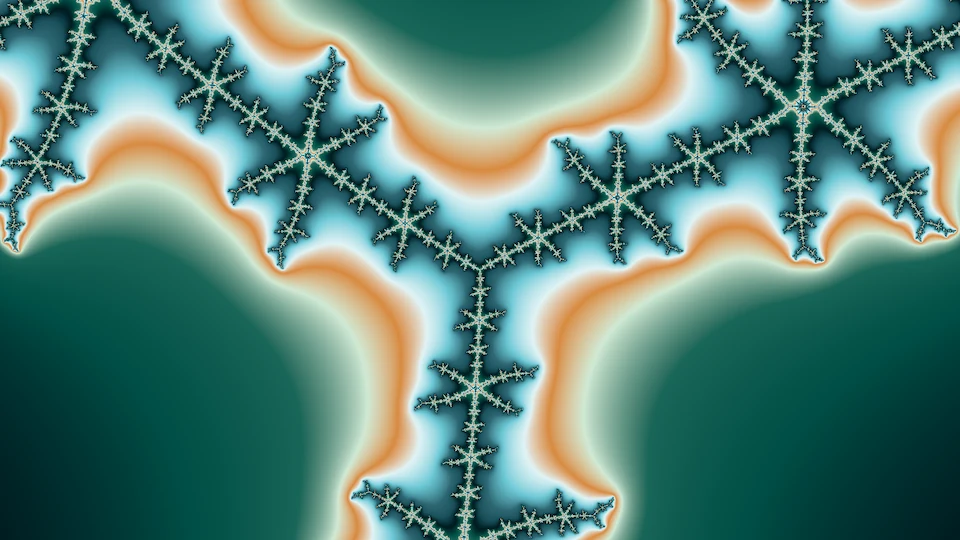
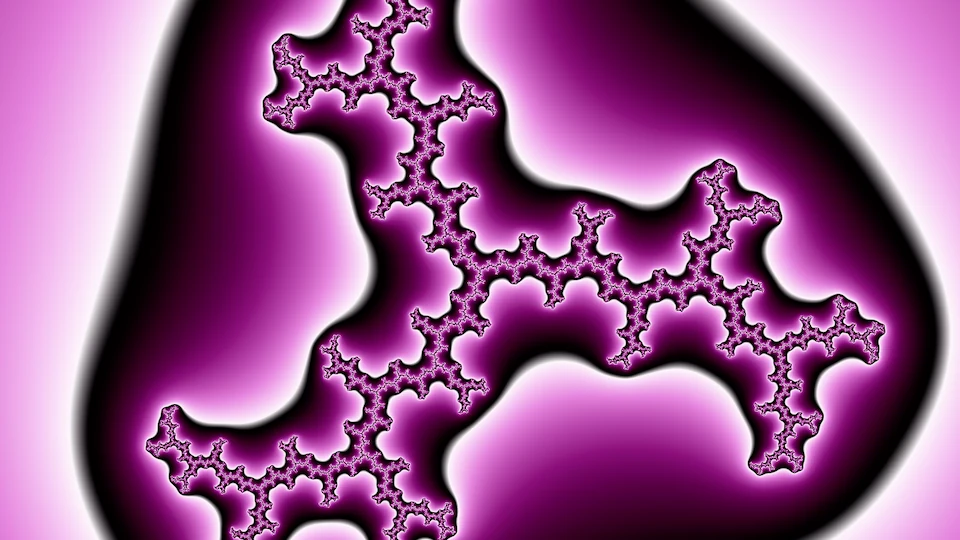
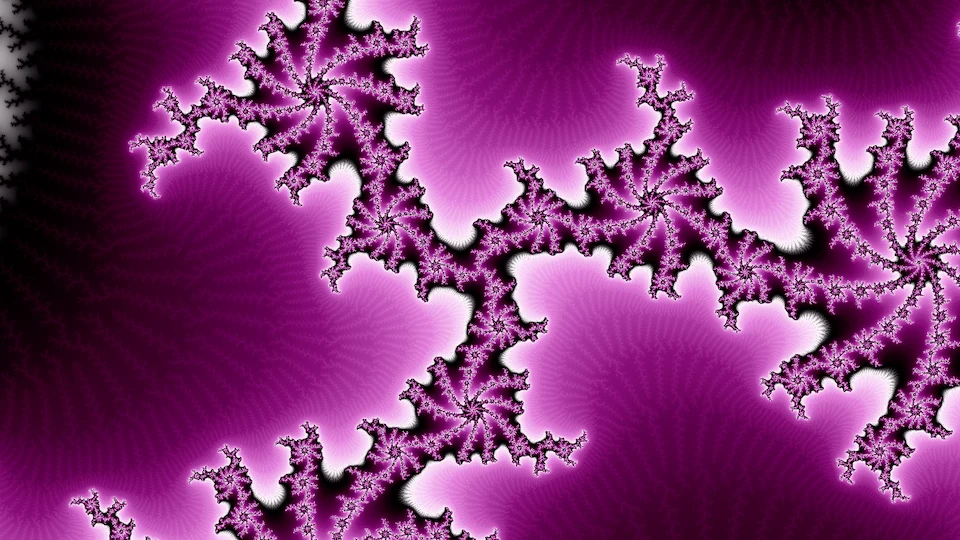
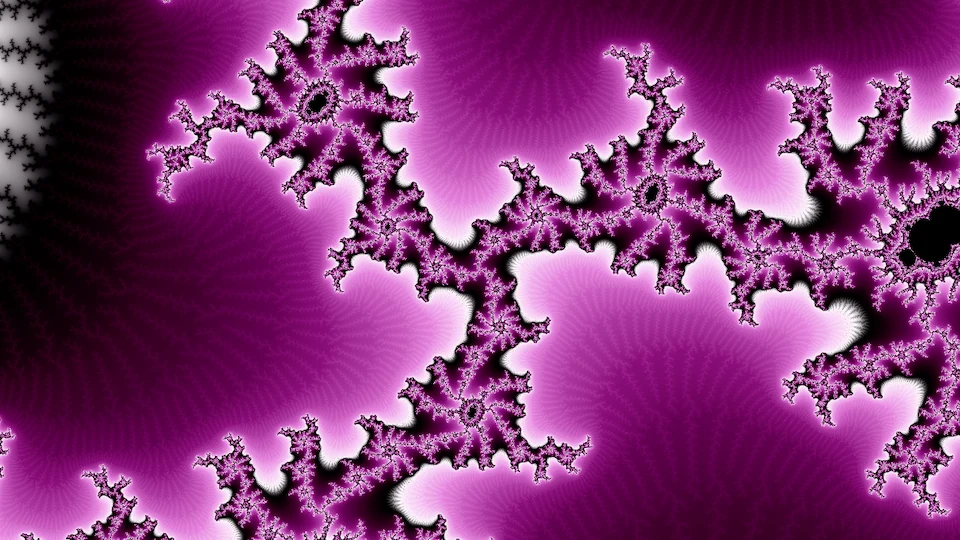
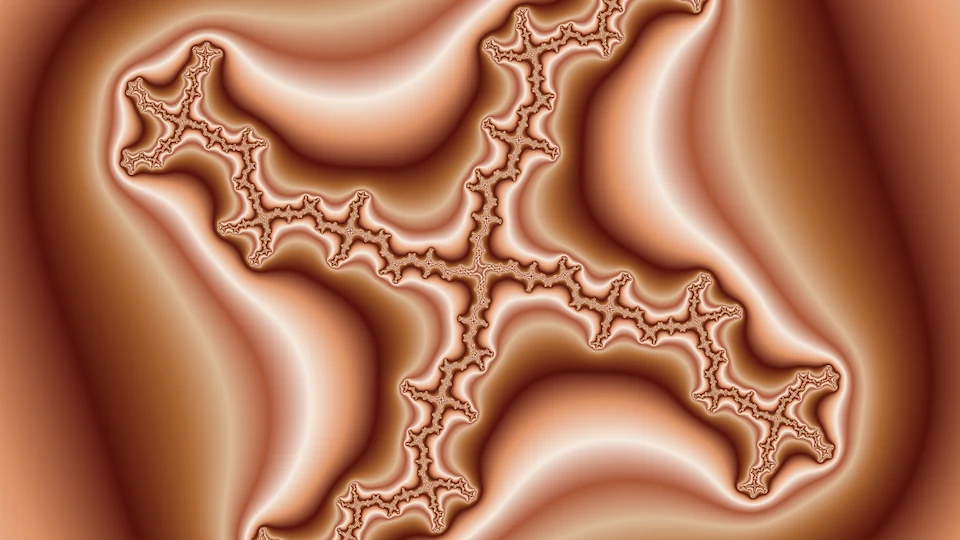
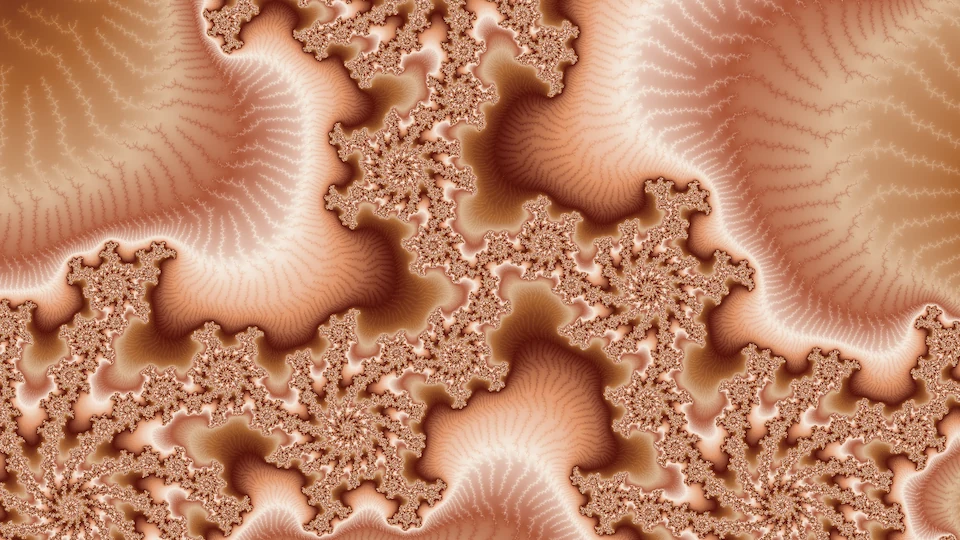
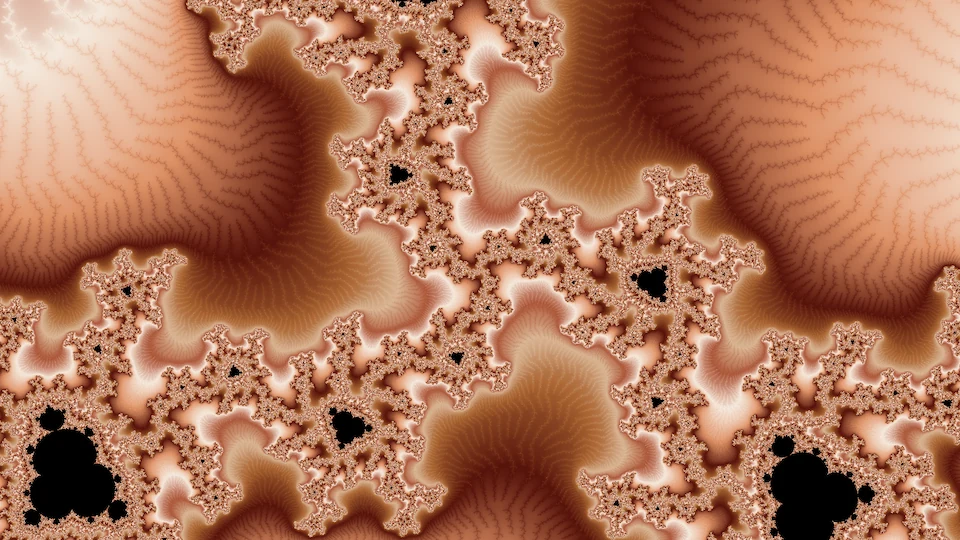
The two meet at the Misiurewicz points, parameters where the orbit of zero never returns to zero but eventually lands on a repelling cycle. Tan Lei proved in 1990 that at such a point the Mandelbrot set zoomed in at c becomes identical, in the limit, to the Julia set for c zoomed in at the same point, up to a scale and a turn: the deeper the zoom, the closer the match. Misiurewicz points are dense in the boundary, so this is true at a dense set of places. The figure below shows one shallow example on the Mandelbrot set and two deep ones on the multibrots, where the same match holds. At depth the filigree agrees almost line for line. The one difference is that the parameter plane also holds tiny copies of the set, which the Julia set does not.
Names for places
Many points of the boundary can be named exactly. External rays come in from infinity at each angle, and a ray at a rational angle lands at a specific point: periodic angles land at the roots of components, and preperiodic ones at Misiurewicz points. Angled internal addresses, due to Lau and Schleicher, name each component by the chain of periods on the way to it from the main cardioid.
Embedded Julia sets
Near a minibrot deep in a zoom, the decorations often arrange themselves into what look like whole Julia sets. They are Julia sets, in a sense: the zoom path to that minibrot fixes a parameter, and the surrounding structure echoes that parameter's Julia set. Deep-zoom artists steer toward them on purpose (Munafo's entry has more).
A distance you can compute
Carrying the derivative of the orbit alongside the orbit gives an estimate of how far a pixel is from the set, and the Koebe quarter theorem guarantees the estimate is right to within a factor of four. That's enough to draw the thinnest filaments at a consistent width, and it's what the slope shading on the Other artistic techniques page is built on.
A boundary as thick as the plane
Shishikura proved in 1998 that the boundary of the Mandelbrot set has Hausdorff dimension 2, the largest anything in the plane can have. The boundary is so wrinkled that, by this measure, it is as large as a filled region. The area of the set itself is known only numerically, about 1.5066.
Pi in the Mandelbrot set
In 1991 Dave Boll noticed something strange at the neck between the main cardioid and the period-2 bulb. Take c = −0.75 + εi for a small ε, and let N(c) be the number of iterations before the orbit escapes. As ε shrinks, ε times N approaches π:
The same thing happens at the cusp, approached along the real axis from outside the set:
(Wikipedia has both.) It also shows why pictures near these points need so many iterations.